Article
From Prototype to Production: A Manufacturing Readiness Roadmap
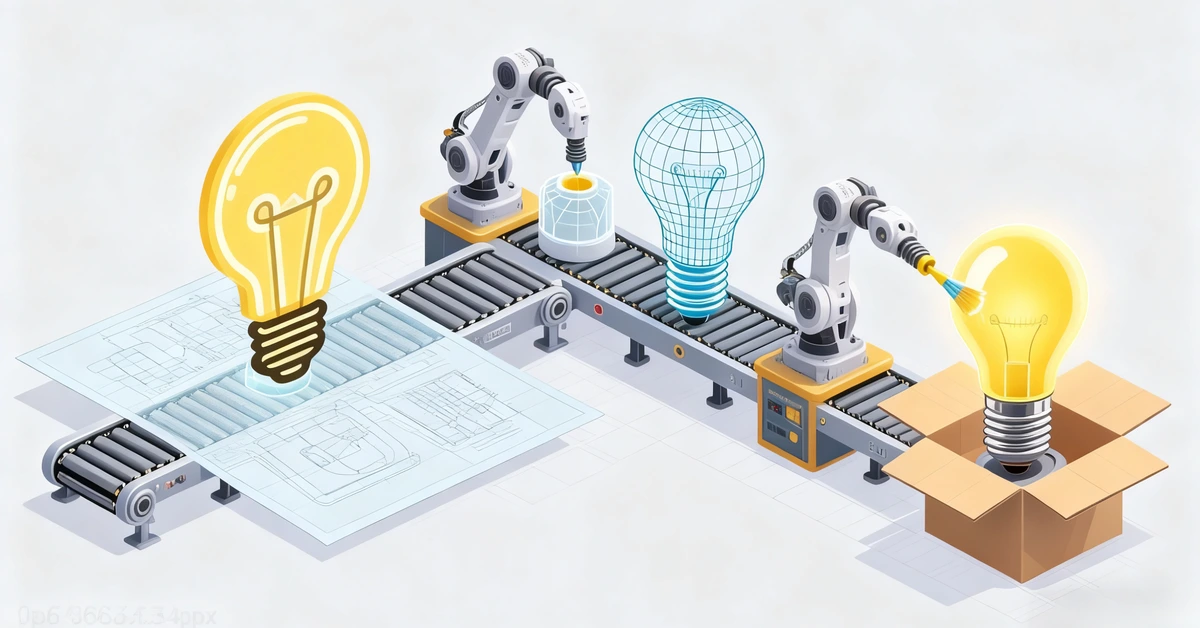
A working prototype proves that an idea can function. It does not yet prove that the product can be built repeatedly, inspected consistently, purchased at the intended volume, or supported after a design change.
For small hardware teams, the difficult part is often the transition between prototype ownership and production ownership. The following roadmap makes that transition visible.
1. Freeze the product intent, not every detail
Before requesting production quotations, define what the product must do and which constraints cannot move.
Useful inputs include:
- application and user environment;
- target performance and duty cycle;
- installation envelope and critical interfaces;
- expected annual quantity and launch timing;
- regulatory, material, cosmetic, noise, or lifetime requirements;
- available drawings, CAD, samples, and test results.
Some details may still be open. Marking them as open items is better than allowing different suppliers to make incompatible assumptions.
Output: a requirements baseline and a list of unresolved engineering decisions.
2. Build the product architecture and supply boundary
Separate the product into parts and processes: motion components, injection-molded parts, sheet metal, electronics, wiring, fasteners, assembly, testing, packaging, and logistics.
For each interface, identify:
- who owns the drawing and revision;
- who supplies mating parts or reference samples;
- which dimensions and characteristics are critical;
- who verifies fit, function, and incoming quality;
- which organization owns tooling and test fixtures.
This is especially important when several Pearl River Delta suppliers contribute to one finished product. A low quotation for an isolated part does not solve an undefined interface.
Output: a preliminary bill of materials, process map, and responsibility matrix.
3. Run DFM before committing tooling
DFM should test whether the proposed design can be made with the intended process—not merely whether a CAD model can be opened.
The review may cover:
- molded-part wall thickness, draft, gates, undercuts, shrinkage, and material;
- sheet-metal bend access, tolerances, joining, finish, and assembly sequence;
- gearmotor operating point, ratio, shaft, connector, mounting, noise, and load profile;
- PCB, wire-harness, enclosure, and service-access interfaces;
- dimensional datums, inspection methods, and realistic tolerance stacks.
Changes at this stage are usually easier than corrections after tooling release.
Output: a reviewed drawing package, DFM action list, and approved technical baseline.
4. Define validation before building samples
A sample cannot pass or fail without agreed conditions. Define the evidence required before ordering prototypes or first articles.
Depending on the product, the validation plan may include:
- dimensional and cosmetic inspection;
- fit and assembly checks;
- speed, torque, current, temperature, or acoustic tests;
- functional tests under representative load;
- environmental or life testing;
- packaging and transport checks;
- customer-side system trials.
Test conditions, sample quantity, acceptance limits, and report format should be written down. Standards and certification requirements should be checked against the current project scope rather than inferred from a supplier brochure.
Output: a validation matrix connecting each requirement to a test or inspection method.
5. Use pilot builds to verify the process
The objective of a pilot build is not simply to produce more samples. It is to test the production route.
Review:
- released drawings and bill of materials;
- incoming-part control and supplier handoffs;
- assembly instructions, fixtures, and operator access;
- in-process checks and final-test coverage;
- traceability, labeling, packaging, and rework handling;
- actual cycle constraints and material availability.
Record deviations and close critical actions before mass-production release. Pilot quantity and timing should match the product risk and process maturity; there is no universal batch size.
Output: pilot-build evidence, corrective actions, and a controlled release decision.
6. Release production with change control
Production readiness is a maintained state, not a one-time meeting. The released drawing, bill of materials, process parameters, test method, approved samples, packaging specification, and supplier list need identifiable revisions.
When a change is proposed, confirm:
- why it is needed;
- which parts, tools, inventory, and tests are affected;
- whether the customer must approve it;
- whether revalidation is required;
- when the new revision becomes effective.
This prevents a well-intended supplier substitution or drawing update from creating an undocumented product change.
Output: a production baseline with approval and revision records.
Where a manufacturing solution provider adds value
A manufacturing solution provider should not hide the specialist suppliers doing the work or imply ownership of every factory. Its value is in making the complete delivery path manageable.
KEY-CRON provides a direct English-speaking project interface and coordinates relevant Pearl River Delta resources for planetary gearmotors, precision injection molding, tooling, sheet metal, electronics assembly and testing, and turnkey manufacturing programs. The exact suppliers, controls, documents, and validation route are selected for the project rather than assumed from a generic capability list.
To begin an evaluation, share the application, current drawing or sample, target performance, annual quantity, and expected launch date. Incomplete information is acceptable if the open questions are clearly identified.